
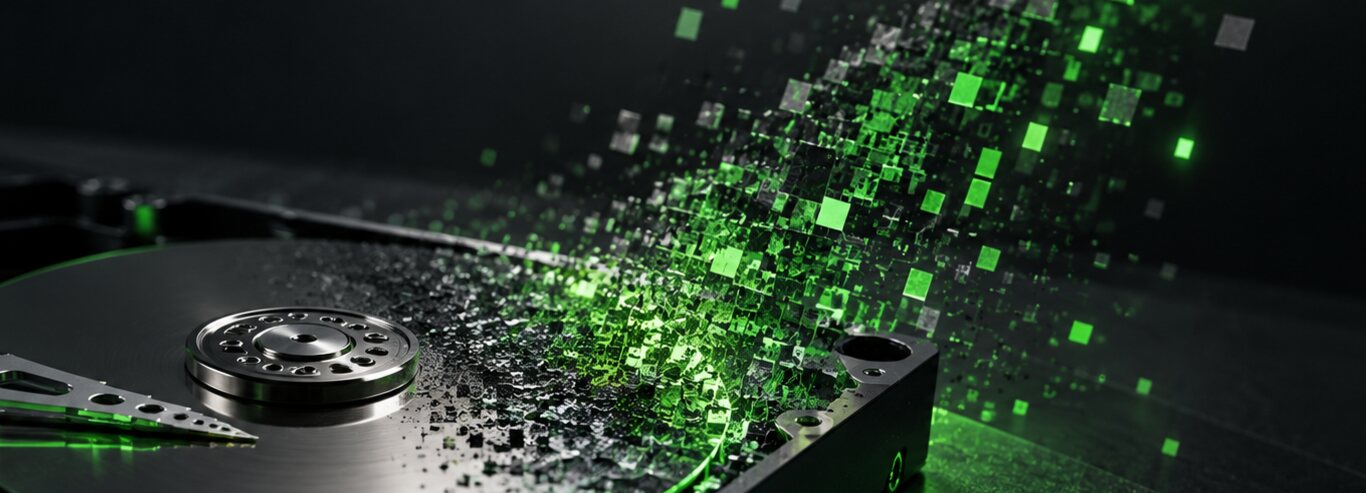
Certified Data Erasure
NIST SP 800-88 & IEEE 2883 Standards
Permanently erase sensitive data from end-of-life devices while preserving hardware value. Audit-ready certificates and full traceability—enabling secure reuse, resale and responsible recycling.
When IT devices reach end-of-life, deleting files is not enough.
Data remains recoverable and poses a compliance risk. Yet destroying every asset destroys residual value and increases e-waste. Certified data erasure solves this dilemma: permanently remove data without destroying the device, enabling reuse, redeployment and resale of functional hardware—with full compliance and audit-ready documentation.
Why certified data erasure matters
- Permanently removes data without destroying the device
- Enables reuse, redeployment and resale of functional hardware
- Demonstrates compliance with GDPR, nLPD and internal governance
- Reduces e-waste by extending equipment lifecycle
Data erasure is the middle path between destruction and discard—it protects data, preserves value, and supports sustainability objectives simultaneously.
Four core pillars
-
Standards-Aligned Sanitisation
Data is permanently removed using NIST SP 800-88 and IEEE 2883 standards. NIST provides established guidelines; IEEE 2883 offers the most recent technical guidance for media sanitisation.
-
Verification & Traceability
Every device is verified and logged. Asset identifiers, erasure method, verification results and operational details are captured for audit-ready documentation.
-
Audit-Ready Documentation
Certificates of Erasure, itemised asset reports, sanitisation method details and verification status—everything governance and compliance teams need to prove secure data removal.
-
Integration with End-of-Life IT
Data erasure connects seamlessly with inventory & logistics, on-site destruction, remarketing and responsible recycling, ensuring every asset follows a coherent, secure path.
Data erasure vs. Physical destruction
Both methods are valid. The right choice depends on data sensitivity, device condition and future value:
Choose Data
Erasure If:
- Device is functional and in reasonable condition
- Residual value recovery is a priority
- Data sensitivity is standard (non-classified)
- Downstream reuse, resale or recycling is planned
Choose Physical
Destruction If:
- Device contains highly sensitive or classified data
- Device is damaged or non-functional
- Policy requires physical destruction of media
- On-site destruction is required for chain of custody
On-site data erasure process : 5 steps
Equipment stays at your premises throughout. No transport before data treatment.
-
1
On-Site Assessment & Preparation
Your devices are assessed on-site for storage media type (HDD, SSD, NVMe), functionality and data presence. We identify which devices can be safely erased and which may require alternative treatment.
-
2
Secure Erasure Setup
Erasure tools are configured on-site or devices are temporarily moved to controlled erasure stations at your location. Network access and power are established for safe, supervised operation.
-
3
Certified Data Erasure
Data is permanently removed using industry-standard software aligned with NIST SP 800-88 and IEEE 2883-2022 Purge standards. Erasure runs on-site under supervision, with immediate verification.
-
4
Verification & Documentation
Post-erasure verification confirms successful data sanitisation. Certificates of Erasure are generated with device-level details, timestamps and operational records.
-
5
Next Step — Reuse, Recycling or Disposition
Erasure-verified devices return to your control or proceed to remarketing, recycling or internal redeployment — all with documented proof of secure data treatment.
Your erasure documentation package
At the end of your data erasure project, you receive:
-
Certificate of Erasure for all devices processed
-
Itemised asset list with serial numbers or asset IDs
-
Operational details (date, time, location)
This documentation supports internal audits, compliance reviews, governance reporting and stakeholder confidence in secure data removal.

Why choose Katana Digital
- Standards-aligned methods (NIST SP 800-88 + IEEE 2883-2022)
- Device-level traceability from intake to disposition
- Audit-ready certificates and comprehensive documentation
- Integration with broader ITAD workflows (remarketing, recycling, destruction)
- Regional coverage across Switzerland, France, Benelux, Germany and Italy
Frequently Asked Questions
-
Deleting files or reformatting a device does not necessarily render the underlying data irretrievable. Certified data erasure uses media-appropriate sanitisation methods aligned with NIST SP 800-88 and IEEE 2883 to render data irretrievable, with verification and documented proof of treatment.
-
Most devices with supported storage media, including HDDs, SSDs and NVMe devices, can be sanitised using appropriate methods. Some older, damaged or technically incompatible devices may not complete erasure successfully. Pre-assessment identifies limitations and determines whether alternative treatment, such as physical destruction, is required.
-
Post-erasure verification confirms that the selected sanitisation process has completed successfully. Verification results are documented and included in the Certificate of Erasure.
-
Devices that fail erasure due to damage, hardware failure or other technical issues are escalated to physical destruction. This is documented and communicated, with corresponding destruction certificates issued.
-
The appropriate sanitisation method depends on the sensitivity of the data, the media type and the organisation’s security requirements. For classified or highly sensitive data, physical destruction may be required or preferred. We assess the requirements and determine the appropriate treatment path.
-
Yes. Once erasure is successfully completed and verified, eligible devices can be reused internally, redeployed, remarketed for resale or sent to responsible recycling. The Certificate of Erasure provides documented proof of data treatment.
Ready to Secure Your Data Erasure Project?
Get in touch to discuss your device inventory, compliance requirements and next steps.
Our other services
-
Certified Data Erasure
Secure data removal for assets that can be sanitised and retained, reused or reallocated. Media-appropriate sanitisation methods aligned with NIST SP 800-88 and IEEE 2883, with verification and documented proof of treatment.
-
On-Site Destruction
Secure physical destruction performed directly at your site. Data-bearing assets are treated before leaving your premises. Witnessed operations, immediate verification and destruction certificates provide documented proof of treatment.
-
Inventory, Logistics & Chain of Custody
Complete asset visibility, secure handling and operational coordination across treatment workflows. Serial number reconciliation, controlled storage, secure transport protocols and documented handovers.